

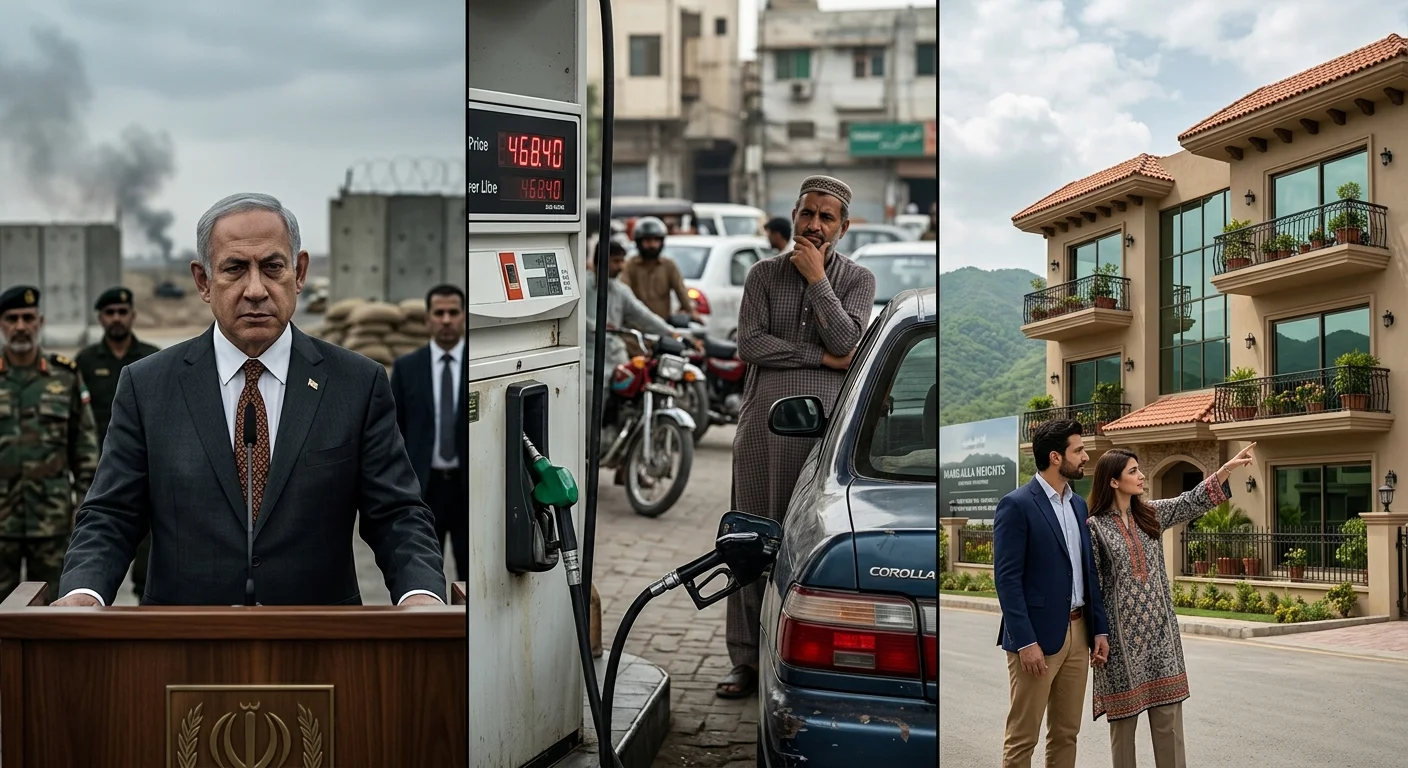
Get The Latest Update About War Conflicts, New Petrol Prices in Pakistan, and New Projects Launched in Islamabad
You filled your tank last week and winced at the bill. Two weeks before that, you paid less. Now you’re paying more again. The new petrol prices in Pakistan change so fast you can barely keep up.
Petrol prices shot up twice in early 2026, hit a record high nobody saw coming, then dropped slightly. The government says one thing. News channels say another. Your neighbor has a theory involving hidden agendas. But strip away the noise, and three things matter: America and Iran locked in a dangerous standoff, Pakistan desperately needing IMF money, and policy decisions hitting your wallet directly.
Meanwhile, your fuel budget is taking a beating. But walk through Islamabad’s Blue Area, and you’ll see cranes everywhere. New towers are climbing skyward. Malls are preparing to open. Money is still flowing into concrete and steel. Both situations tell you exactly where Pakistan’s economy stands right now.
Let me walk you through what’s actually happening and what you should do about it.
New Petrol Prices in Pakistan Snapshot
| Metric | Figure |
| Current Price | Rs 378/litre |
| Peak Price (March 2026) | Rs 458.40/litre |
| Starting Price (Jan 2026) | Rs 268/litre |
| Total Increase | +41% from January |
| Inflation Impact | Jumped to 26.8% in March |
Price Timeline: How We Got Here
| Date | Change | New Rate |
| February 2026 | +Rs 55 | Rs 323/litre |
| Early March 2026 | +Rs 137 | Rs 458.40/litre |
| 4th April 2026 | -Rs 80 | Rs 378/litre |
What Is the New Price of Petrol in Pakistan?
You’re paying Rs 378 per litre at most stations right now. The Oil and Gas Regulatory Authority announced this rate on April 4th after cutting Rs 80 from the previous price.
Getting here was brutal. February brought a Rs 55 jump. March delivered another Rs 137 increase, pushing the new petrol prices in Pakistan to Rs 458.40 per litre. That’s the highest price Pakistan has ever seen. Those two weeks in mid-March broke household budgets across the country.
Why Petrol Prices Are Increasing in Pakistan 2026
Four factors drove the increases:
Global oil markets spiked
Brent crude climbed from around $78 per barrel in January to $92 by mid-March. Pakistan imports over 80% of our crude oil. When global benchmarks rise, we feel it within days.
Middle East tensions exploded
The US-Iran standoff heated up early this year. Iran threatened the Strait of Hormuz, through which roughly 21% of the world’s oil passes daily, according to the U.S. Energy Information Administration. That threat alone pushed traders to buy at higher prices. Oil futures jumped $8 per barrel in one week. Pakistan’s import bill absorbed that hit directly.
IMF demanded higher revenue
Pakistan’s IMF program requires cutting subsidies and boosting tax collection. The petroleum development levy jumped from Rs 50 to Rs 70 per litre. The Extended Facility agreement explicitly requires maintaining adequate petroleum levies to meet revenue targets.
The rupee kept sliding
The rupee dropped from approximately Rs 278 per dollar in January to Rs 285 by March. We pay for oil imports in dollars. Every rupee that weakens makes those imports costlier.
Put these four together, and you get the new petrol prices in Pakistan we’re dealing with now.
What Is the Price of PSO Today in Pakistan?
Pakistan State Oil follows OGRA’s official rate, currently, Rs 378 per litre for petrol. Diesel runs Rs 382 per litre. PSO operates over 3,500 retail outlets nationwide, so their pricing sets the benchmark most other retailers follow.
What is the Petrol Price in Pakistan today, 13 March 2026?
On March 13th, the new petrol prices in Pakistan hit Rs 321.17 per litre. OGRA’s fortnightly notification locked in that rate. It held for three weeks before the April reduction brought some breathing room.
How the Israel-Iran War Affects Petrol Prices
The Strait of Hormuz sits at the center of this. Only 21 miles wide at its narrowest point. Connects the Persian Gulf to the Gulf of Oman. About 21 million barrels flow through daily.
When US, Israel, and Iran start trading threats and strikes, oil markets panic. Iran has threatened closure before during conflicts. Traders don’t wait for actual disruption. They price in the risk immediately. That’s what drove Brent crude up $8 per barrel in a single week when tensions spiked.
Israel’s strikes on Iranian positions in Syria keep things unstable. Iran backs Hezbollah in Lebanon and militias across Iraq and Yemen. Each escalation adds uncertainty. Markets hate uncertainty. Prices climb on fear alone.
Why Is America Fighting Against Iran?
It stems mainly from the nuclear program. The US pulled out of the nuclear deal in 2018 and reimposed sanctions. Iran gradually stopped following nuclear restrictions in response. The US maintains pressure through economic sanctions. Iran sees this as warfare by another name and pushes back through regional proxies.
Neither side wants full-scale war. But limited strikes and confrontations keep happening. That ongoing instability affects global energy markets, and we pay the price here.
Who Started the War With Iran in 2026?
There’s no formal war declaration. What exists is escalating confrontation. The US hits Iranian-backed militias. Iran supports proxy groups across multiple countries. Each side blames the other for provocations. Decades of mistrust and competing regional interests fuel the conflict.
Has a US Fighter Jet Been Shot Down in Iran?
Verified defense sources confirm drone losses on both sides, but no confirmed manned US fighter jet shootdowns inside Iranian territory as of April 2026. Claims circulate on social media regularly, but major news agencies and defense departments haven’t verified such incidents.
Who Supports Iran in War?
Hezbollah in Lebanon. Houthi forces in Yemen. Shia militias in Iraq. All receive Iranian financial and military support. Russia and China back Iran diplomatically at the UN Security Council and maintain trade relationships despite US sanctions pressure.
Why Is Iran So Important to the World?
Iran controls the world’s fourth-largest proven crude oil reserves and second-largest natural gas reserves, according to BP’s Statistical Review of World Energy. They sit on the northern coast of the Strait of Hormuz. Their regional influence stretches across multiple countries through political alliances and proxy relationships.
For Pakistan specifically, any Middle Eastern supply disruption or price spike hammers our import bill since we rely heavily on imported energy.
What Is the Oil Price Today?
Brent crude trades between $85 and $88 per barrel as of April 2026. West Texas Intermediate sits around $81 per barrel. Elevated compared to 2023 levels but below previous crisis peaks.
Why Did Fuel Prices Spike So Fast?
OGRA’s pricing formula accounts for international benchmarks, exchange rates, inland freight, dealer margins, and taxes. When multiple inputs move against you simultaneously, retail prices jump hard.
What hit us in early 2026:
- Brent crude rose $14 per barrel (January to March)
- Rupee depreciated 2.5% against the dollar
- Petroleum levy increased Rs 20 per litre (Rs 50 to Rs 70)
- Remaining subsidies removed per IMF requirements
Beyond the numbers, geopolitical fear added what traders call a risk premium. When Iran threatened Strait disruptions, oil futures reacted within hours. Brent crude trading volume jumped 40% that day. Prices rose $6 per barrel in one session. Physical oil kept flowing, but markets price in potential future problems. That fear drives prices up before any actual shortage materializes.
Globally, tight OPEC+ production quotas, underinvestment in refining capacity over the past decade, and sanctions redirecting Russian oil trade all contributed to elevated baseline prices. Pakistan’s weak rupee and fiscal pressures requiring higher petroleum taxes amplified the impact locally.
Impact of Global Oil Prices on Pakistan Economy
Higher oil prices widen our current account deficit. Petroleum imports consume approximately 25% of total import spending according to State Bank data. When oil jumps:
- Import bill balloons in dollar terms
- More rupees needed for the same volume
- Foreign exchange reserves face pressure
- Inflation accelerates as transport costs ripple through the economy
The new petrol prices in Pakistan pushed headline inflation to 26.8% year-on-year in March from 24.1% the previous month. That’s not abstract economic data. That’s your grocery bill. Your rent. Your school fees.
How Fuel Prices Affect Daily Life in Pakistan
Transport hits you first. Rickshaw drivers raised fares overnight. Taxi and ride-hailing apps adjusted rates upward. Bus operators increased ticket prices. Pakistan Railways bumped fares 12% in March citing diesel costs.
Then the effects spread. Groceries cost more because trucks burn expensive diesel getting produce to markets. Manufacturers running on generators pay more for backup power. Delivery services slap surcharges on orders. Small business profit margins evaporate.
Pakistan Bureau of Statistics shows households in the lowest income bracket spend roughly 8% of their budget on transport. When fuel jumped 73% from Rs 268 to Rs 458, that budget couldn’t stretch. Families had to sacrifice somewhere else. Less meat on the table. Delayed medical visits. Kids pulled from tuition classes.
I spoke with a bakery owner whose monthly fuel bill went from Rs 40,000 to Rs 75,000. He couldn’t raise bread prices fast enough to cover costs. His margin disappeared. He came within days of shutting down before the April price reduction gave him breathing room.
Who Benefits From High Oil Prices?
Oil-exporting nations win big. Saudi Arabia, UAE, Iraq see revenue climb without producing extra barrels. Their national budgets balance around $70-80 per barrel, so anything above becomes windfall profit.
Refineries and oil majors benefit from wider margins when crude costs less than refined product prices.
Commodity traders profit from volatility through futures and options positions.
Who loses? Oil-importing developing countries like Pakistan. Our import bill climbs. Fiscal deficit widens. Inflation accelerates. Ordinary households lose purchasing power while stuck salaries can’t keep pace.
Is It Good Time to Invest in Islamabad Property 2026?
Despite economic turbulence, Islamabad’s property market holds steady. Blue Area specifically maintains demand for concrete reasons.
The Capital Development Authority restricts new commercial construction zones. Blue Area’s boundaries are fixed. No new land gets added. Meanwhile, federal government employment stays stable. The diplomatic community needs housing and office space regardless of short-term economic troubles. That demand doesn’t vanish.
Property acts as an inflation hedge. Real assets hold value better than cash deposits when inflation runs at 26%. Commercial properties in Blue Area generate 6-8% annual rental yields, beating most fixed-income alternatives.
One major consideration matters though. With policy rates at 19-20%, debt-financed purchases only make sense if rental income covers interest payments comfortably. Cash buyers sit in a much stronger position.
What Is New Project in Blue Area Islamabad?
Several major developments launched recently:
Tower 12 Islamabad combines office floors with ground-level retail near Jinnah Avenue. The developer successfully completed three previous Islamabad projects. Pre-leasing reached 60% before construction finished.
Pak Land Tower 1 and Pakland Tower 2 target corporate tenants seeking Grade A office space. Tower 1 sits at 75% occupancy. Tower 2 pre-leasing continues strong. Both offer backup power, modern HVAC systems, and secure parking.
Elan Square Islamabad features smaller commercial units designed for startups and small businesses. Co-working operators leased multiple floors. Ground retail targets cafes and professional services.
Elysium Mall brings Islamabad’s first international-standard shopping experience to Blue Area. Major cinema operator already signed. Several international retail brands committed to anchor positions.
Citadel 7 Islamabad delivers luxury residential with smart home integration. Biometric access and 24/7 security monitoring. Target market is senior executives and diplomatic staff.
Aspen Tower Islamabad provides mid-range commercial office space priced between premium towers and older inventory. Appeals to law firms, consulting agencies, and professional services.
Sina 16 Islamabad mixes retail on lower floors with residential apartments above. This dual-use approach captures both commercial and residential demand streams.
The Allegiance Islamabad offers premium residential with comprehensive amenities. Backup generators, water treatment systems, fitness facilities, and concierge services. Popular with overseas Pakistanis seeking professionally managed properties.
Investment opportunities Islamabad 2026 concentrate on commercial real estate in Blue Area due to supply constraints and fundamentally sound demand.
Is Petrol Flammable?
Yes, highly flammable. Petrol ignites easily and burns rapidly. Vapors can ignite at temperatures as low as -43°C. That’s why petrol stations prohibit smoking and require engines off during refueling. Store petrol only in approved containers away from heat sources and open flames.
Which Country Is Petrol Cheapest In?
Venezuela has the world’s cheapest at roughly $0.02 per litre due to massive government subsidies. Libya, Iran, and Kuwait also maintain very low domestic prices. These are major oil producers that heavily subsidize consumption. Pakistan imports over 80% of petroleum needs, so we can’t replicate subsidized pricing models.
What Is Petrol Made From?
Crude oil extracted from underground reserves. Refineries use fractional distillation to separate crude into different components based on boiling points. Petrol is a hydrocarbon mixture containing 4 to 12 carbon atoms that vaporizes between 30°C and 200°C. Refineries then blend it with additives to boost octane rating, reduce engine knocking, and clean fuel injectors.
How Can I Save Money on Petrol?
Drive smoother. Gentle acceleration and gradual braking improve fuel efficiency 10-15%. Aggressive driving burns fuel fast for no gain.
Maintain tire pressure. Check weekly. Underinflated tires increase rolling resistance and reduce fuel economy 3-4%.
Eliminate idling. Turn off your engine if stopped more than 30 seconds. Idling burns fuel without moving you anywhere.
Plan smarter routes. Combine multiple errands into single trips. Use navigation apps to avoid traffic congestion. Every unnecessary kilometer costs money at Rs 378 per litre.
Use public transport. Metro bus systems cost significantly less per kilometer than private vehicles.
Carpool with colleagues. Share rides. Split fuel costs. Can cut individual transport expenses by half or more.
Consider CNG conversion. If your vehicle supports it, CNG costs substantially less per kilometer. Conversion kits typically pay for themselves within 12-18 months for regular drivers.
Fill up during cooler hours. Fuel is denser when cool. You get fractionally more volume per rupee in early morning.
Compare station pricing. Rates vary Rs 2-3 per litre between locations. Use apps that track local pricing differences.
Combine these strategies and you can realistically cut monthly fuel costs 15-20%.
What Happens Next With Petrol Prices?
Several factors will determine where the new petrol prices in Pakistan head from here:
Middle East situation. Further escalation pushes oil higher. Diplomatic progress could ease pressure and lower prices.
IMF program compliance. Pakistan’s next loan tranche requires meeting strict fiscal targets. The petroleum levy likely stays at current levels even if international prices drop.
Exchange rate trajectory. Rupee stability determines how global price movements translate locally. State Bank policy and foreign exchange inflows become critical.
Global economic activity. Slowdown in major economies reduces oil demand and eases prices. Strong growth supports higher prices.
OGRA reviews and adjusts prices every two weeks based on international market movements. Expect continued volatility rather than stable pricing through 2026.
Final Thoughts
The new petrol prices in Pakistan stem from compounding pressures. Global instability. Domestic fiscal stress. Currency weakness. No single villain. Multiple forces working against household budgets simultaneously.
For families struggling with costs, focus on practical fuel-saving measures. Small changes in driving habits and route planning accumulate meaningful savings over months.
For investors with available capital, Islamabad property provides inflation protection despite economic headwinds. Blue Area projects maintain value due to genuine supply limitations and steady underlying demand.
Pakistan has weathered economic storms before. This period demands careful financial management and informed decision-making. Stay aware of price trends. Adjust household budgets proactively. Base investment choices on fundamentals rather than speculation or panic.
Conditions will eventually stabilize. Until then, how you manage available resources makes the real difference between just surviving and actually protecting your financial future.